
On this page

This is Part 3 of 3 in Understanding Today's Crypto Market. If you haven't read the earlier pieces, start with Part 1: What actually happened to crypto? and Part 2: How crypto rebuilt itself.
Engaging with crypto differently today
One of the biggest changes in today's crypto market is not technological. It is behavioural.
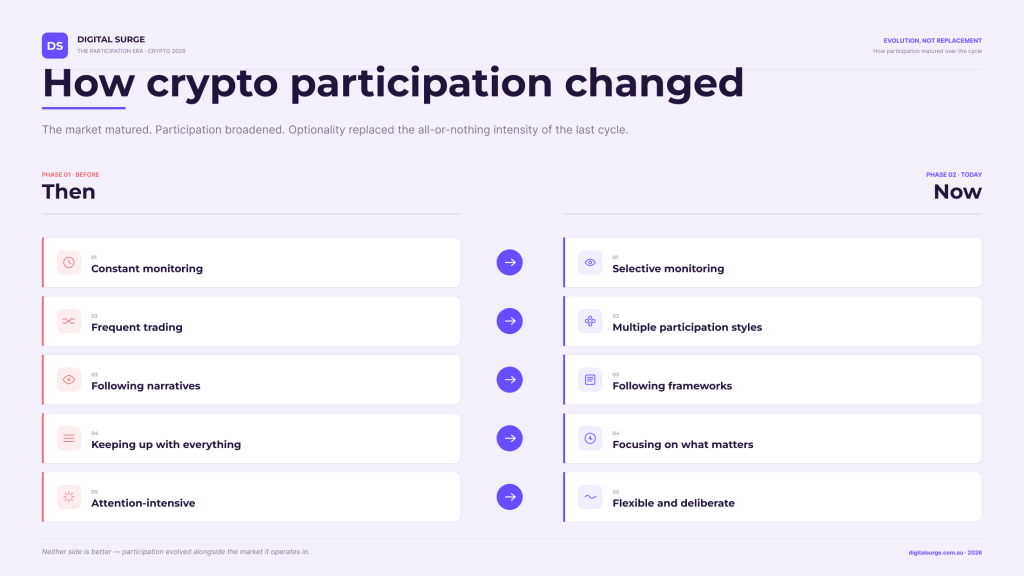
Just a couple of years ago, crypto participation often felt constant. Markets moved rapidly, social media amplified every rally and correction, and many people felt pressure to stay permanently connected to the market. Chart-checking became routine. Narratives changed weekly. Staying on top of everything became part of the cost of participation.
For many people, it eventually became unsustainable.
The challenge wasn't simply volatility. It was the feeling that there was always something happening somewhere, and that missing it meant falling behind. New narratives emerged, entire sectors rose and fell in popularity. The market rewarded constant engagement, and maintaining that pace became increasingly difficult.
Today, the dynamic feels different.
For many people, whether they remained engaged throughout recent cycles or are returning after time away, the question is no longer “how do I keep up with everything?” It is “what mode of participation actually fits my life?”
That shift may be one of the healthiest developments to emerge from recent cycles. As the market matured, the way people engaged with it matured alongside it. Engaging with crypto no longer has to mean constant monitoring. For many people, it now looks less like a full-time hobby and more like a long-term interest that can be approached deliberately, at a pace that suits the individual.
Modes of participation
There is no longer a single way to engage with crypto.
One of the quieter changes across recent cycles has been a shift away from the idea that everyone should engage with the market in the same way. Smaller positions held over longer periods, less focus on daily movement, and greater emphasis on adoption now describe how many people engage with the market. Trading and investing represent different relationships with the same asset class, and understanding that distinction often matters more than any individual position.
Different approaches suit different goals, time horizons and circumstances. None is automatically better than the others. The point is to choose deliberately rather than drift into an approach that does not match the life around it. The challenge is not choosing the "right" approach, but understanding which one aligns with your objectives, risk tolerance and available time.
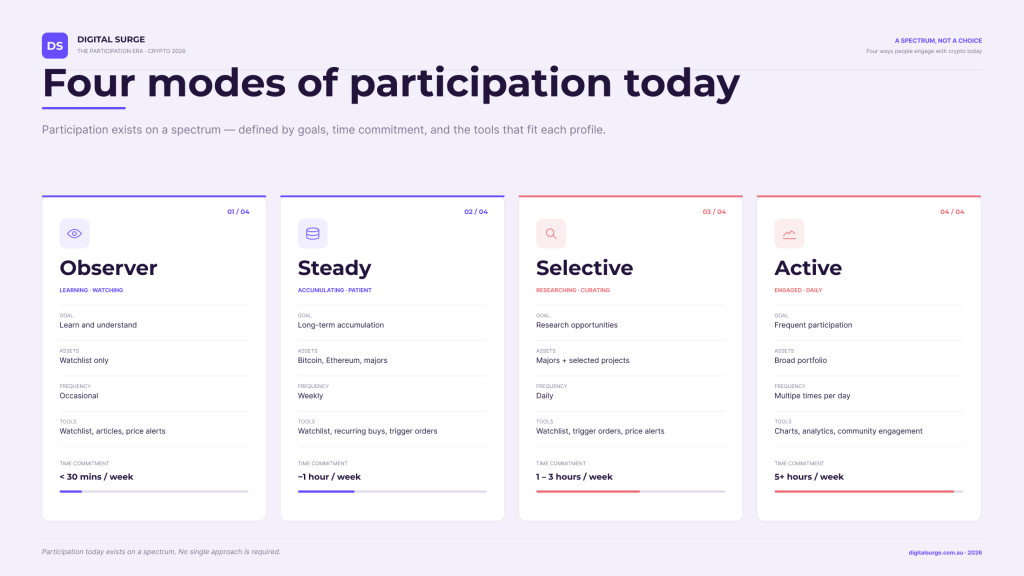
The observer follows the market without holding positions. They read market updates, watch major developments and gradually build context over time. Some eventually return to investing, while others simply prefer to stay informed without actively participating.
The steady participant makes small, regular purchases into a limited number of familiar assets. They maintain a short watchlist, set a handful of price alerts and largely ignore the day-to-day noise. The focus is consistency rather than constant activity.
The selective participant holds deliberate, researched positions and treats portfolio construction seriously. Reviews tend to happen quarterly rather than daily, with greater focus on structural developments such as ETF flows, regulatory milestones and infrastructure adoption than to short-term price movement.
The active participant engages more closely with market cycles, emerging assets and changing narratives. They typically use more research tools, spend more time following developments and accept higher volatility in exchange for exposure to faster-moving parts of the market.
Most people who return successfully do not fit neatly into just one of these categories. Instead, they combine elements of several approaches.
One of the most common patterns among experienced crypto investors is maintaining a core position intended for the long term while allocating a much smaller portion of capital to higher-risk or more speculative opportunities. Each serves a different purpose and is managed differently as a result.
That separation matters. When long-term positions and speculative activity become blurred together, short-term decisions can begin to undermine long-term goals. Keeping the two distinct is one of the more practical lessons many participants carry from one cycle into the next.
The return of patience
One of the least-discussed changes in crypto is that many people simply became more patient.
Earlier cycles often rewarded speed. Narratives moved quickly, attention was constant, and success was frequently associated with being first. New sectors emerged rapidly, social media amplified every trend, and many people felt pressure to react immediately or risk being left behind.
The market now looks different.
While active trading remains an important part of the ecosystem, many investors now spend more time thinking about years than weeks. ETF investors, long-term Bitcoin holders and recurring-buy strategies are all examples of engagement that operates on longer time horizons.
This shift is visible beyond individual investors. Some of the largest pools of capital entering the market are not positioning for the next few weeks or months. They are making decisions based on multi-year views around adoption, infrastructure and the role digital assets may play within broader financial systems.
That does not mean speculation has disappeared. New narratives still emerge, markets still move quickly, and periods of intense excitement continue to attract attention. But increasingly, they exist alongside a growing group of participants who are focused less on predicting the next move and more on understanding the broader direction of travel.
For many people, that change has made crypto easier to engage with. Participation no longer has to mean constant monitoring. It can mean setting a plan, following a process and allowing time to do some of the work.
Choice has become part of the challenge
One of the practical challenges of today’s crypto market is not volatility. It is choice.
For much of crypto’s history, access was the challenge. There were fewer platforms, fewer assets and fewer ways to participate. Simply finding reliable information or gaining exposure to digital assets often required a level of effort that kept many people on the sidelines.
Today, the situation is almost the opposite.
The number of digital assets available has expanded enormously. Many platforms now list hundreds of assets, while public blockchains collectively support millions of tokens. New projects launch every day, particularly on networks designed to make token creation fast and inexpensive. Mindshare itself has become scarce in a way it was not several years ago.
In earlier cycles, when Bitcoin moved, much of the rest of the market often moved with it. Broad themes dominated. Capital flowed through a relatively small universe of assets, and entire sectors could rise together.
The market is now more fragmented. With so many assets, sectors and narratives competing for capital and mindshare, outcomes are far more dispersed. Some projects attract long-term adoption. Others fade quickly. Many move independently of one another. Which assets someone follows, and why, matters more than it once did.
This is why selection has become as important as access itself.
For many people, success is no longer about keeping up with everything. It is about deciding what deserves focus in the first place.
Simple frameworks can help
When the market becomes harder to filter, a simple framework becomes more useful.
Picking which digital assets to pay attention to is no longer the straightforward question it once was. The market today rewards a more selective approach: slower, more selective and more aware of how an asset actually works before it earns a place on a watchlist.
That does not mean every participant needs to become a full-time analyst. It simply means the first question has changed. Rather than asking “what is moving today?”, a more useful starting point is often “why is this digital asset worth following at all?”
A basic framework can be reduced to five questions:
- Liquidity: can the asset actually be bought or sold at the quoted price?
- Distribution and unlocks: who owns the supply, and when does more enter circulation?
- Market cap, FDV and supply mechanics: is supply growing faster than demand?
- Volatility: how much of the movement is the asset class versus the asset itself?
- On-chain behaviour: what are holders and users actually doing?
None of these questions guarantee the right answer. They simply create a more disciplined way to think about an asset before spending meaningful time researching it.
Resources such as the Asset Discovery Zone can help Digital Surge users explore some of the factors that influence how digital assets behave. They do not recommend specific assets. They are designed to support better questions, so readers can apply them on their own terms.
Signal versus noise for less frequent check-ins
For anyone who does not want to engage with the market every day, the question eventually becomes: what is actually worth paying attention to?
One of the advantages of a longer-term approach is that not everything deserves the same amount of time. Some developments can influence the direction of the market for months or years. Others generate a great deal of discussion while having little lasting impact.
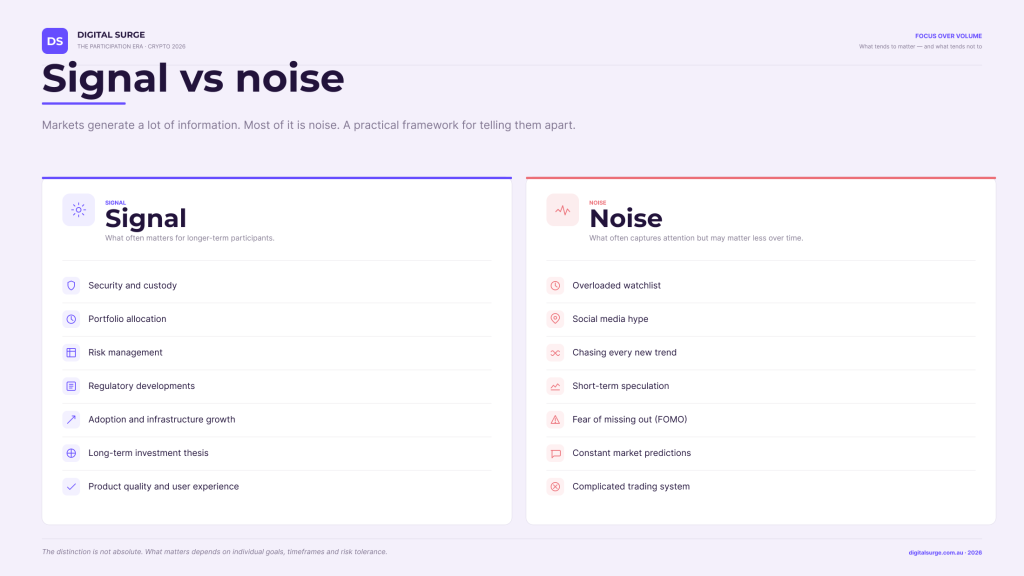
Worth checking monthly
- ETF flows and other institutional capital movement
- Regulatory milestones in major jurisdictions
- Stablecoin and real-world-asset adoption
- Major infrastructure upgrades
- Broader macroeconomic conditions affecting risk assets
- Australia-specific developments under the evolving digital asset framework
Usually not worth checking daily
- Minute-by-minute price movements
- Short-term social media sentiment
- Broad "alt season" calls
- Influencer signals and group-chat trades
- Coverage framing specific assets as guaranteed outcomes
Neither list is exhaustive, and there will always be exceptions. Markets can move unexpectedly, and short-term developments occasionally become important longer-term trends.
The principle behind the distinction is straightforward: the signals that tend to matter most usually operate on longer timeframes than the ones that demand the most immediate reaction.
For many participants, one of the most useful habits is learning to separate information that helps improve decisions from information that simply creates urgency. The two often look similar in the moment, but they rarely have the same long-term value.
Tools that support different styles
The shift in how people engage with crypto is often reflected in the tools they choose to use.
Someone taking an observer approach may simply want a watchlist, a few price alerts and a way to stay across major developments.
For a steady participant, consistency often matters more than activity. Recurring buys can automate regular purchases, while watchlists and alerts help keep attention focused on a small number of familiar assets.
Those who take a more selective approach typically spend more time researching before acting. Educational resources, including the Asset Discovery Zone, can help them explore the factors that influence how digital assets behave, while watchlists and alerts help them monitor only the assets they have chosen to follow.
More active participants may rely on broader asset coverage, research tools and real-time market information to engage with changing narratives, emerging assets and shorter-term opportunities.
Most people do not fit neatly into a single category. A long-term recurring buy can sit alongside a watchlist of future opportunities. Someone may spend months observing before deciding to act. A smaller speculative allocation may exist separately from a longer-term position.
The point is not that every participant needs every tool. It is that the right tools can help crypto participation become more deliberate, less reactive and better matched to the pace someone actually wants.
A deliberate approach, on your own terms
Over the course of this series, we've explored what happened during one of the most challenging periods in crypto's history, how the industry rebuilt through infrastructure, regulation and institutional adoption, and how participation itself evolved along the way.
What ties those stories together is a simple idea: crypto grew up.
The market became larger, more diverse and more mature. But perhaps more importantly, many of the people participating in it matured as well.
The emotional intensity that defined parts of previous cycles was never the only way to engage with crypto. It was a feature of a younger market and a younger industry. Today's market offers more ways to participate, more ways to learn and more ways to stay engaged without feeling compelled to follow every headline, every narrative or every price movement.
For some people, engaging with crypto means watching and learning. For others, it means building a long-term position gradually over time. Others will remain active, researching new assets, exploring new opportunities and following developments more closely.
None of these approaches is inherently right or wrong. The important thing is that the approach is intentional.
Whatever pace fits, observer, steady, selective or active, the way back in does not need to be dramatic.
It simply needs to be chosen.
Ready when you are
Everything discussed throughout this series is already available to explore at Digital Surge.
Whether you're building a watchlist, setting price alerts, researching assets through educational resources, exploring the Asset Discovery Zone or establishing a recurring buy, the tools are there to support a range of participation styles and engagement levels.
Australian-operated, AUSTRAC-registered and supporting customers through multiple market cycles, Digital Surge is designed to help Australians engage with crypto at a pace that suits them.
You don't need to have all the answers today. You don't need to follow every market movement. You don't even need to decide which participation style fits you immediately.
Start by exploring. Build a watchlist. Learn about the assets that interest you. Set a few alerts. See what resonates.
The tools are ready. The framework is yours. The pace is up to you.