
On this page

What actually happened to crypto?
Five years ago, crypto felt unstoppable.
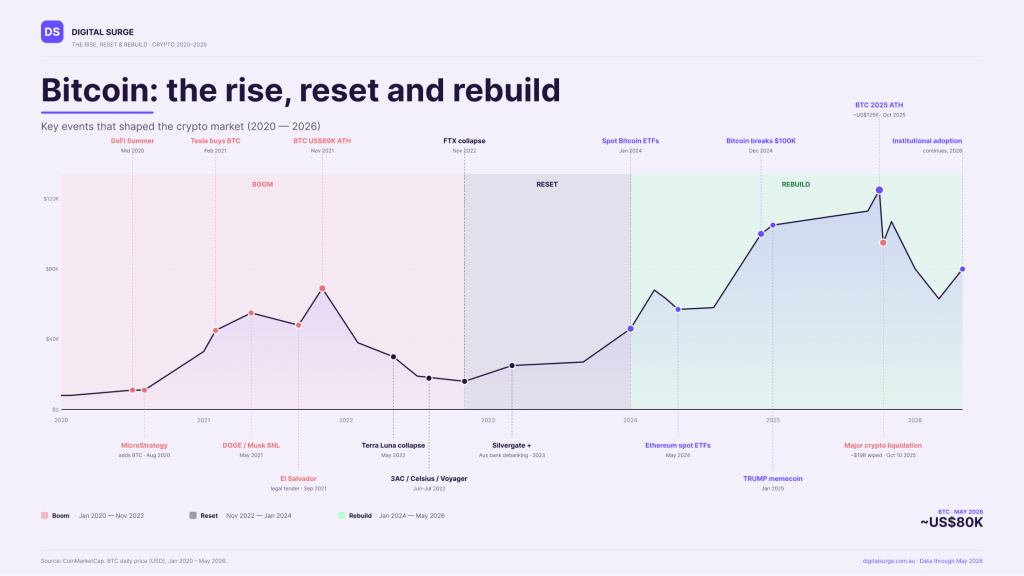
Bitcoin was reaching new highs, Ethereum was powering an entirely new wave of decentralised finance, and millions of new participants were entering the market for the first time. Mid 2020 became known as "DeFi Summer". Uniswap, Aave and Compound emerged almost overnight as new financial primitives built openly on-chain, while Ethereum gas fees surged as the network strained under unprecedented demand. Online communities formed around tokens, memes and narratives that could move billions of dollars within days. What began as excitement gradually evolved into something far more speculative, fast-moving and emotionally intense.
By late 2020, the conversation had broadened well beyond retail. MicroStrategy (now Strategy) began adding Bitcoin to its corporate treasury, followed by a small but growing list of public companies. For the first time, Bitcoin was being discussed seriously as a treasury reserve asset rather than purely as a speculative trade.
In early 2021, Tesla added Bitcoin to its balance sheet, accelerating the narrative even further. Coinbase listed on NASDAQ — valued at over US$80 billion on its first day of trading — one of the most prominent crypto-native companies to publicly debut on traditional markets. El Salvador became the first country in the world to make Bitcoin legal tender. Each headline pulled crypto further into mainstream view.
And as the cycle accelerated, crypto became deeply intertwined with internet culture itself.
Dogecoin became one of the clearest examples of this shift. Originally created as a joke cryptocurrency, DOGE evolved into a global speculative phenomenon as memes, celebrity attention and social media increasingly influenced market behaviour. Elon Musk's tweets regularly moved markets, while his May 2021 appearance on Saturday Night Live became one of the defining cultural moments of the cycle.
Alongside Dogecoin, NFTs exploded into the mainstream. CryptoPunks and Bored Ape Yacht Club became status symbols. Beeple sold a digital artwork at Christie's for US$69 million. For a brief window, NFTs felt as though they might redefine ownership of digital culture entirely. Digital ownership, internet identity and speculative markets increasingly merged into the same cultural phenomenon.
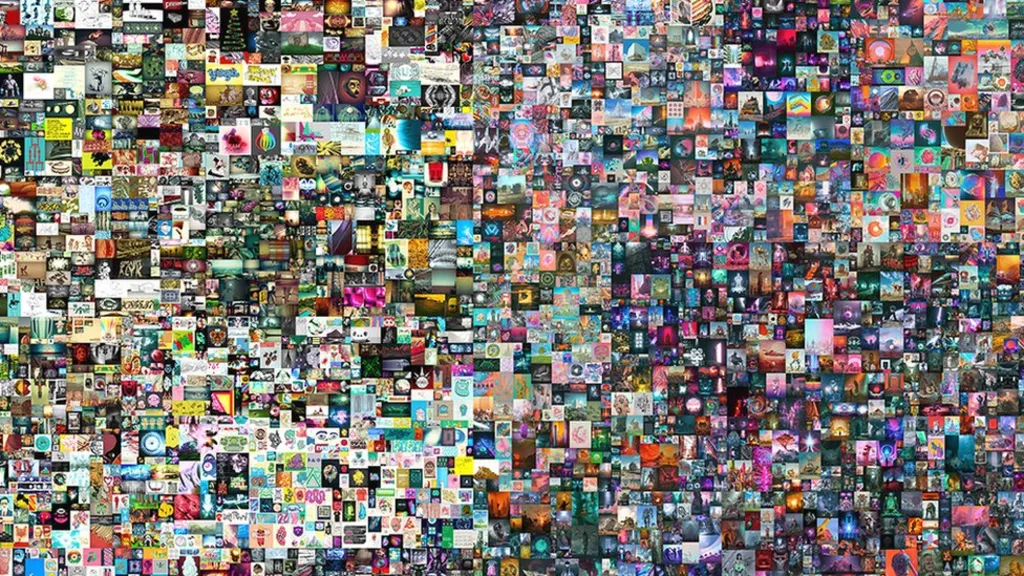
By late 2021, Bitcoin had pushed to a new all-time high of around US$69,000 and the total crypto market capitalisation had crossed US$3 trillion. The market had never felt larger, louder or more confident.
When the cycle reversed
At the time, it felt entertaining. In hindsight, it also revealed how emotionally charged and attention-driven the market had become. Markets reacted to attention and virality rather than underlying fundamentals. Speculation accelerated across riskier parts of the ecosystem. Behind the scenes, leverage and interconnected counterparty exposure had also expanded significantly. Many businesses depended not only on rising prices, but on the assumption that liquidity and confidence would remain available indefinitely.
Then the cycle reversed.
What followed was one of the largest credibility resets in modern financial history. The collapse of Terra Luna in May 2022 triggered a chain reaction across the broader market. TerraUSD lost its dollar peg, LUNA fell from over US$100 to near zero within days, and the contagion spread quickly. Three Arrows Capital, the crypto hedge fund that had borrowed heavily from Celsius, Voyager and BlockFi, collapsed first. As its positions imploded, the contagion moved straight through its lenders' balance sheets and into their customers' accounts. Celsius froze customer withdrawals. Voyager filed for bankruptcy. BlockFi soon followed. A credit crisis tore through crypto lending at the same time as prices were falling.
Then came FTX.
At one point, FTX was viewed as one of the most credible companies in crypto. It had global sponsorships, celebrity endorsements and major institutional backing. Its collapse in November 2022 fundamentally changed how many people viewed exchanges, custody and platform trust across the industry. It also marked the bottom of the cycle for Bitcoin and much of the broader crypto market.
The impact was not abstract.
The failure of FTX affected customers around the world, including many Australian users. The impact also reached beyond FTX's direct customers, extending to many other platforms with operational exposure to the FTX ecosystem. Digital Surge was among them. For many users across many platforms, the collapse was not only a market event. It changed how an entire industry thought about counterparty risk, custody standards and operational resilience.
For many people who lived through that period, it was not just financially damaging.
It was emotionally exhausting.
The aftershocks continued into 2023. Silvergate Bank, one of the most important banking partners for the crypto industry, wound down operations, followed shortly by Signature Bank. What became known informally as "Operation Choke Point 2.0" saw banking access for crypto businesses tighten significantly across the United States. In Australia, the major banks (CBA, Westpac, NAB and ANZ) introduced their own restrictions on payments to crypto exchanges, reshaping how Australians moved money in and out of the market for much of the next two years. Australians began experiencing delayed transfers, declined deposits and in some cases account restrictions specifically tied to crypto activity, making access to local exchanges more friction-filled than at any point in the previous five years.
The conversation around crypto changed significantly after that. Investors began asking harder questions about where customer assets were actually held, how transparent operations really were, what operational safeguards existed, how regulated a given business actually was, and whether it could survive periods of market stress.
The industry that emerged afterwards looked very different from the one that entered the cycle.
The market that emerged
After the reset, the picture became more complex.
Speculation didn't disappear. If anything, it intensified in new forms. Memecoins continued to draw enormous attention, with AI-themed coins, celebrity tokens and politically-branded assets all emerging in the following cycle. Internet culture and asset issuance remained deeply intertwined.
But alongside that, a very different layer of the market began emerging underneath. Institutions entered more formally. Crypto-native infrastructure continued advancing through the bear market, even when the public conversation focused elsewhere. Regulation matured globally and in Australia. The structure of the market itself began to feel meaningfully different from the one that defined the previous cycle.
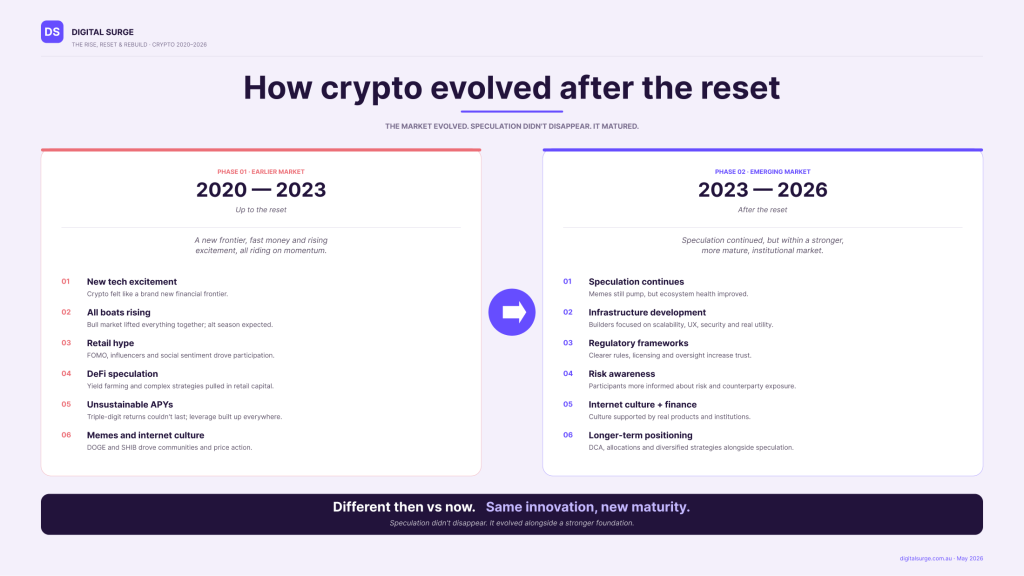
In Australia specifically, exchanges operating through this period faced increasing expectations around compliance, custody and operational resilience. Digital Surge has been one of the local platforms adapting alongside this evolving environment.
Crypto still carries risk. Volatility still exists, speculation still exists, and not every project will survive.
But the market that emerged after the reset is very different from the one that dominated the previous cycle.
The central question is no longer simply: "What could go up next?"
It is increasingly: "What has real infrastructure, real transparency and real staying power?"
That is a very different conversation from the one we saw five years ago.
This is Part 1 of 3 in Understanding Today's Crypto Market. Continue reading: Part 2: How crypto rebuilt itself explores what was actually being built while the headlines focused on collapse.